The Urbanixm Knowledge Discovery Engine is a collection of tools for gathering web content about urbanism, extracting information about urban policy and infrastructure interventions, and making that information easier to find. It pays particular attention to the sustainability impact of urban interventions.
Context
Urbanixm supports sustainable urban development through custom data analysis, case-study research, and interactive decision-support tools that combine global best practice with knowledge of local context. The Knowledge Discovery Engine supports this work by organizing information about the built environment.
My role and contribution
Software Engineer and Applied Data Scientist. I developed the application end-to end.
How it works
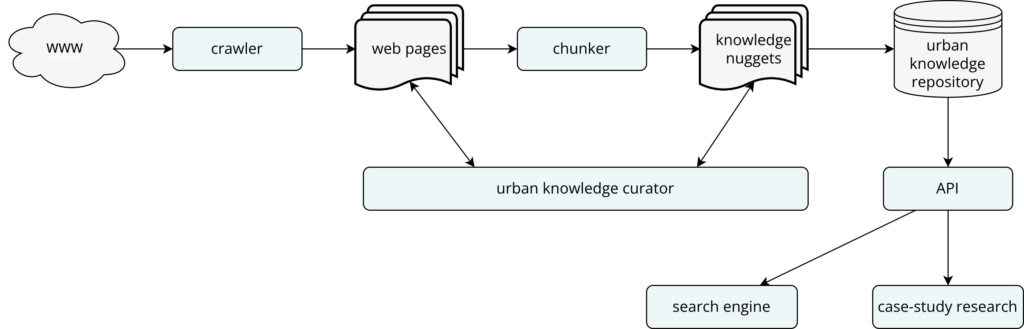
The engine collects content from sources such as local authority websites, news sites, urbanism blogs, and research reports. An information-curation pipeline extracts information about urban policy, infrastructure implementation, intervention impacts, and statistical characteristics of places. The resulting knowledge is stored in an urban knowledge repository.
The system includes:
- Web crawler: Finds web pages that may be relevant to urbanism, including scientific articles, project reports, and press releases.
- Knowledge curator: Uses classifiers to identify relevant and quotable pages, urbanism topics, and places. It also annotates smaller text passages, or knowledge snippets, with topics, places, and narration types such as implementation, policy, impact, or place statistics.
- Knowledge repository: Stores the annotated information for use by downstream services.
Outcome
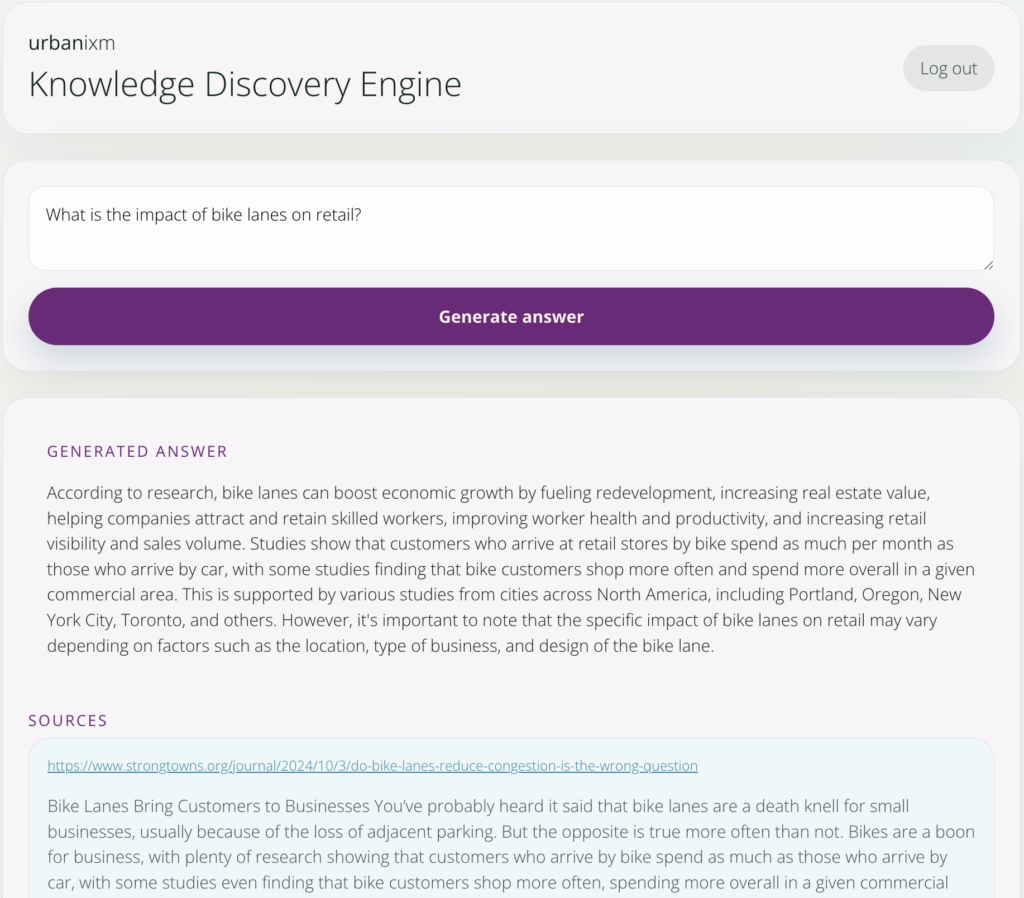
The repository supports Urbanixm’s search engine, case-study research services, and urban impact and milieu stories.
Technology
Python, LangChain, retrieval-augmented generation (RAG), large language models (LLMs), information retrieval